A quiet, still pond might look harmless, but beneath the surface, it can quickly turn into a hotspot for mosquito activity. This is because stagnant water creates conditions that naturally attract egg-laying mosquitoes, often without any visible warning signs. In fact, in many residential and commercial landscapes, poorly circulated ponds become a recurring source of mosquito problems, especially in warmer months. While chemical treatments are often considered, they are not always a sustainable or effective treatment for mosquito control for ponds. This raises an important question: what actually makes stagnant water so appealing to mosquitoes, and how can it be managed more efficiently?
To get an answer to this, you need to read our blog that explains this in detail. Let’s begin!
Mosquito Prevention and Pond Aeration OverviewStagnant pond water creates favorable conditions for mosquito breeding by supporting egg laying, larval development, and stable aquatic habitats. Proper aeration helps disrupt multiple stages of the mosquito life cycle through improved circulation, oxygen distribution, and water-column mixing. Maintaining adequate pond depth, strategic diffuser placement, clear flow paths, and balanced vegetation further supports a healthier pond ecosystem that is naturally less conducive to persistent mosquito activity. |
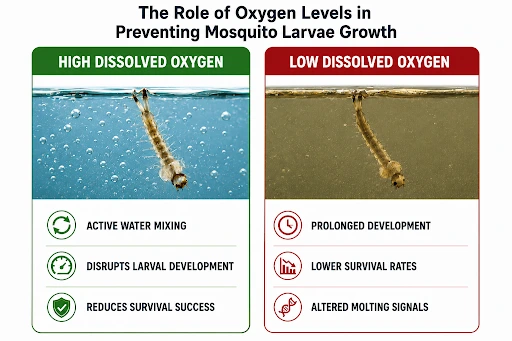
The Role of Oxygen Levels in Preventing Mosquito Larvae Growth
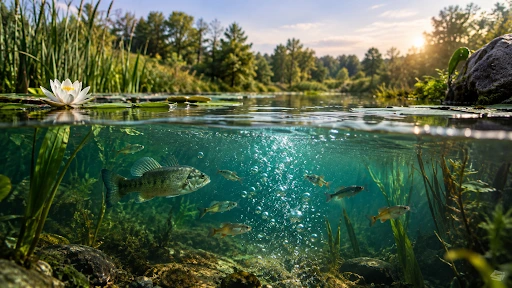
Oxygen levels play a crucial role in limiting mosquito larvae growth in stagnant water. Mosquitoes prefer low-oxygen, still environments because their larvae rely on surface breathing and thrive where there is minimal water disturbance. In oxygen-rich water, typically achieved through aeration or circulation, increased microbial activity and movement disrupt larval development and reduce survival rates. In fact, a study published in the Journal of Vector Ecology found that reduced dissolved oxygen levels can prolong larval development and decrease survival rates, indicating that oxygen availability influences mosquito physiology beyond simple respiration. As a result, ponds with stable oxygen dynamics and active water mixing create less consistent physiological conditions.
How Pond Aeration Systems Disrupt Mosquito Breeding Cycles?
Discourages Egg Laying by Creating Continuous Surface Movement
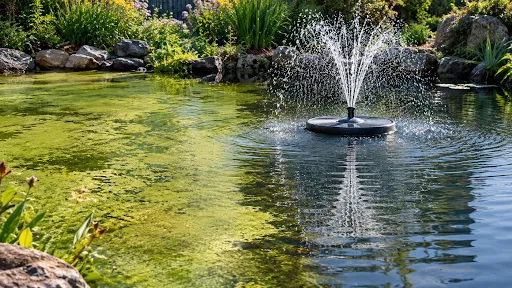
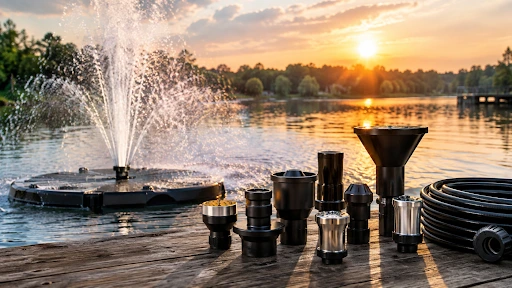
Female mosquitoes are more likely to lay their eggs in calm, stagnant water where their offspring have a better chance of surviving. Pond aeration systems help keep the water in motion, preventing still pockets from forming around pond edges and other low-circulation areas that mosquitoes often target. As the water continues to circulate, the pond becomes less appealing as a breeding site, especially with a floating water fountain. This ongoing surface movement can therefore help interrupt the mosquito life cycle before eggs are ever laid.
Limits Adult Emergence by Disrupting the Pupal Transition
The pupal stage is the last aquatic stage in a mosquito’s life cycle. During this time, mosquito pupae need to stay at the water’s surface while the adult mosquito emerges and allows its wings to expand before taking flight. When a pond aeration system creates continuous surface movement, it can make this process more difficult by reducing the stability that pupae rely on. In open areas of the pond, where there is little shelter from water movement, this disruption can decrease the number of mosquitoes that successfully emerge as adults.
Reduces Larval Food Availability Through Faster Organic Decomposition
Organic materials such as leaves, algae, pollen, and fish waste naturally settle at the bottom of a pond over time, causing nutrient-rich sediments to accumulate. However, a pond aeration system increases dissolved oxygen levels, which helps aerobic bacteria break down this organic matter more efficiently. This process can be complemented by adding black pond dye & cleaner to your pond. As a result, the microorganisms and fine organic particles that mosquito larvae commonly feed on become less abundant, making the pond a less favorable environment for their growth and development.
Strengthens Natural Biological Control
Mosquito larvae depend on microorganisms and fine organic particles in the water for nourishment during their development. In poorly circulated ponds, decaying leaves, algae, and other organic matter can accumulate, creating nutrient-rich conditions that support these food sources. Pond aeration helps increase dissolved oxygen levels, which in turn supports aerobic bacteria that break down organic material more efficiently. Over time, this reduces the abundance of larval food sources, making it more difficult for mosquito larvae to survive and develop into pupae.
Prevents Thermal Stratification That Creates Favorable Breeding Zones
During warmer months, deeper ponds often develop thermal stratification, where warm surface water remains separated from cooler bottom water. This creates isolated areas with consistently warm temperatures that accelerate mosquito egg hatching and larval growth while allowing breeding habitats to remain stable for longer periods. A bottom-diffused pond aeration system continuously circulates water throughout the pond, breaking down these temperature layers and distributing heat more evenly. By preventing long-lasting warm zones from forming, aeration creates a less predictable environment for mosquito development and reduces the pond’s overall suitability for repeated breeding.
Ways to Keep Pond Water Circulating and Mosquito-Free
Position Pond Diffusers Strategically for Maximum Water Circulation
Installing a pond aerator is only part of the solution; the placement of the diffuser is equally important. If diffusers are positioned too close to the shoreline, they may leave sections of the pond with little to no water movement. For the best results, bottom diffusers should be placed in deeper areas where they can circulate the greatest volume of water and promote full water-column mixing, making it more difficult for mosquitoes to establish breeding sites.
Maintain Adequate Pond Depth
Shallow water warms quickly and is more likely to remain stagnant, making it ideal for mosquito breeding. The study mentioned in the UNIVERSITY OF CALIFORNIA Agriculture and Natural Resources consistently notes that mosquito larvae prefer shallow habitats, particularly those less than 24 inches (2 feet) deep. So where it is possible, ponds should incorporate deeper sections with steeper transitions rather than broad, shallow shelves.
Keep Inlets, Outlets, and Spillways Clear
Inlets, outlets, and spillways play an important role in maintaining consistent water movement throughout a pond. Over time, leaves, sediment, algae, and aquatic vegetation can obstruct these flow paths and reduce circulation efficiency. Hence to make it easy, regular inspection and cleaning help water move evenly across the entire pond, preventing sections from becoming isolated and supporting a more balanced, well-circulated aquatic environment.
Inspect Pumps, Diffusers, and Air Lines Regularly
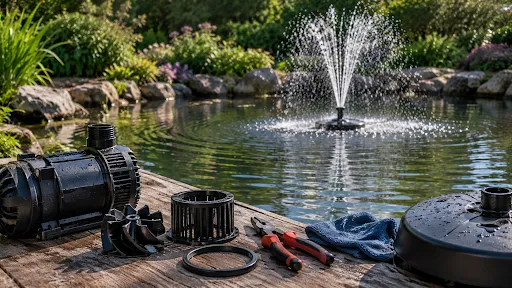
Regular maintenance is essential to keep pond circulation systems operating at peak efficiency. Over time, diffusers can become clogged with mineral deposits and biofilm, while air lines may develop leaks or blockages that reduce airflow. Similarly, worn compressor components can lower system output without obvious signs of failure. Therefore, proactive pond maintenance and periodic system inspections are essential to maintain proper circulation across the pond.
Conclusion
A healthy pond is defined by movement, balance, and consistent water quality, not by still, stagnant conditions that allow mosquitoes to thrive. Therefore, investing in proper circulation helps support a more resilient aquatic environment. To get you right, Friendly Fountains offers you an efficient and reliable pond solution. Through customized aeration solutions, equipment maintenance, and water quality services, our team helps pond owners maintain cleaner, better-circulated ponds that are naturally less conducive to mosquito activity. So contact us to get an efficient solution for your pond.
FAQs
Which areas of a pond should homeowners inspect first for mosquito breeding?
Focus on stagnant edges, plant-dense sections, shallow shelves, and any areas where debris restricts water movement.
Can mosquitoes breed in my pond even if the water looks clean?
Yes, mosquitoes can breed in clean water as long as it remains still enough for eggs and larvae to survive.
How quickly can aeration help reduce mosquito activity around my pond?
Many pond owners notice a reduction in mosquito activity within a few weeks as circulation improves and breeding conditions become less favorable.
Should aeration systems be resized as ponds mature over time?
In some cases, yes. Increased sediment buildup, expanded vegetation, and changing pond depths may require adjustments to maintain optimal circulation.
My pond is less than two feet deep; can I still use aeration to stop breeding?
Yes, but because larvae thrive in shallow water under 24 inches, you should pair aeration with regular plant thinning to ensure the moving water actually reaches the shoreline.