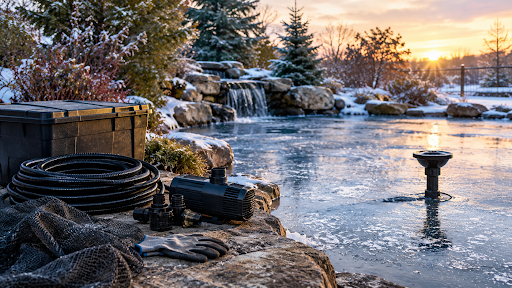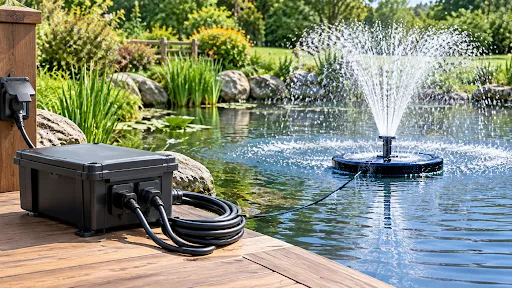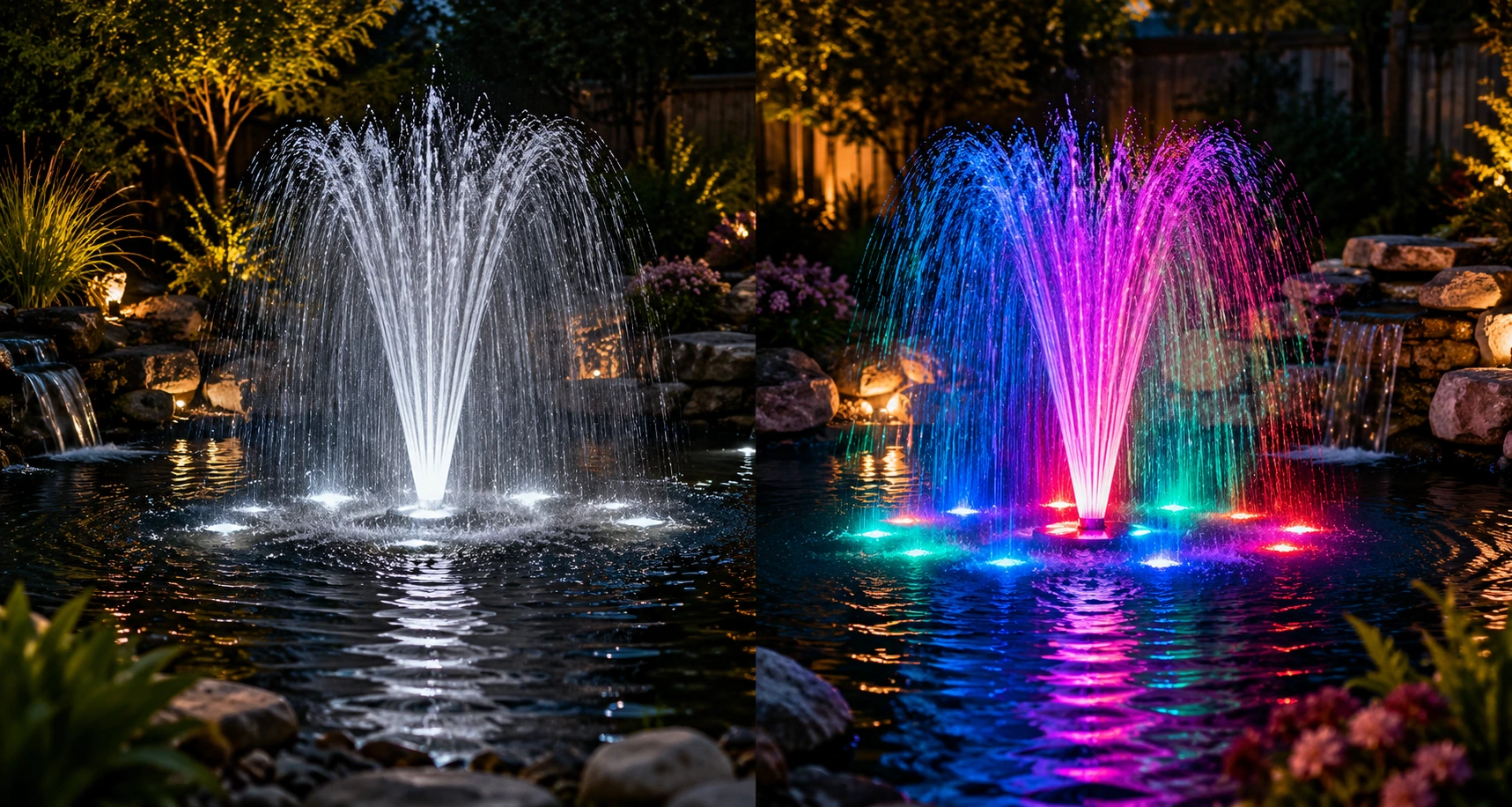
Choosing the right fountain lighting can completely change the vibe of a backyard pond. Some homeowners prefer the clean, elegant glow of white LED fountain lights, while others love the vibrant effects and customizable ambiance of color-changing options. Both styles enhance water features, but they create very different visual experiences after sunset. The final output depends on optical performance factors such as lumen distribution, beam uniformity, and color rendering efficiency, which collectively determine how accurately the fountain structure and water motion are visually defined in low-light conditions.
Before making a decision, let’s explore the key differences between white and color-changing LED fountain lights and determine which option best suits your backyard space.
White vs Color Lighting Summary
White and color-changing LED fountain lights differ in design, operation, efficiency, and visual output, offering distinct aesthetic experiences for backyard ponds. White LEDs deliver stable, high-efficiency illumination ideal for enhancing clean water texture, while color-changing systems provide automatic color cycling and visual variety that suit different moods and occasions. Selection depends on application focus, ease of use, and desired visual impact. Proper lighting enhances water clarity, improves nighttime visibility, and elevates overall pond aesthetics. Modern LED systems ensure energy efficiency, safe low-voltage operation, and compatibility with various fountain configurations for long-term performance and design versatility.
What Are White and Color-Changing LED Fountain Lights?
White and color-changing LED fountain lights are underwater fixtures designed to illuminate water features, including lighting for fountains and decorative ponds.
- White LED lights emit clean, bright, or warm white light, offering a traditional, elegant look ideal for formal fountains.
- Color-changing LED lights use multi-chip diodes to produce multiple lighting effects, including a continuous automatic rotation through colors upon powering on.
Both types are energy-efficient, low-voltage, and weatherproof with stainless steel housings.
Key Differences Between White and Color-Changing Pond Lights
The key differences between white and color-changing pond lights can be understood by comparing their technical design, control systems, and lighting behavior as outlined below:
| Parameter | White LED Fountain Lights | Color-Changing LED Fountain Lights |
| Light Source Technology | Typically, single CCT (Correlated Color Temperature) LED chips | RGB or RGBW LED arrays using mixed-die semiconductor control |
| Spectral Output | Narrow, fixed spectrum with stable lumen output | Broad, tunable spectrum achieved via PWM mixing of red, green, blue (and sometimes white) channels |
| Control System | On/Off or dimmable drivers with limited control complexity | Simple plug-and-play operation; lights power on automatically and cycle through colors continuously, no remote, app, or control panel required |
| Energy Efficiency | Higher efficiency due to single-diode operation | Slightly lower efficiency due to multi-channel blending losses |
| Color Rendering | High consistency, stable CRI depending on LED binning | Variable CRI depending on programmed color output |
| Electrical Complexity | Simple constant-current driver | Simplified multi-channel driver with straightforward circuit design, keeping costs accessible |
| Application Focus | Architectural, stable illumination for water texture enhancement | Automatic color-cycling for dynamic visual appeal and mood-enhancing ambiance across backyard pond settings |
How Does Each Lighting Type Affect Backyard Pond Aesthetics?
Lighting plays a key role in shaping how a backyard pond is visually experienced at night, influencing clarity, mood, and overall design perception.
White Lighting: White lighting enhances a backyard pond fountain lights by making its structure and natural elements clearly visible without altering their real appearance. It brings out the true colors of stones, plants, and water, allowing the pond to look authentic even at night. The steady illumination reduces visual distractions and helps the eye focus on design details such as edges, depth changes, and water movement. It also supports a calm and orderly outdoor setting, where every feature feels well-defined and easy to interpret. This type of lighting works especially well in contemporary landscapes where simplicity and clarity are important design goals.
- Shows natural pond colors accurately
- Improves visibility of structural details
- Highlights water movement clearly
- Reduces visual clutter
- Fits clean, modern landscape design
Color Lighting: Color lighting changes the overall perception of a backyard pond by introducing adjustable visual tones that influence how the space is experienced. It allows different parts of the pond to stand out through contrast, especially when combined with reflections on moving water. Using multi-color LED lights for a fountain helps create flexible visual effects that can shift the pond’s appearance depending on the setting or occasion. It also enables dynamic styling where the pond can feel calm, festive, or dramatic without altering its physical structure. This makes the space more adaptable for different moods or outdoor events while maintaining visual interest.
It is worth noting that color-changing LED lights are available in a wide variety and range. Entry-level options offer a cost-effective and straightforward solution, when plugged in, the lights automatically power on and continuously rotate through colors without requiring any control panel, remote, or additional setup. This simplified, plug-and-play design keeps the product accessible and easy to operate while still delivering the visual appeal of dynamic color cycling. More advanced systems may include additional programmable features, but the basic rotating models remain a popular and practical choice for everyday backyard pond use.
- Alters the visual mood through color tones
- Creates contrast with reflections on water
- Enables flexible lighting effects
- Supports mood-based outdoor styling
- Adds adaptability for different occasions
How to Choose the Right LED Fountain Lights for Your Pond Setup?
Selecting the right LED fountain lights depends on how you want your pond to function and appear at night, along with the level of visibility and atmosphere you want to create.
- White color LED light for a fountain is suitable when the priority is clear illumination, helping you see water flow patterns and fountain movement naturally and straightforwardly. They work well for practical setups where the focus is on visibility and a simple, clean presentation of the water feature.
- On the other hand, color LED lights are better for enhancing visual appeal, allowing the fountain to stand out as a decorative highlight with changing tones that suit different moods or outdoor settings. They are ideal for spaces designed for entertainment or creative landscaping where visual variety is important.
When choosing, also consider installation compatibility, brightness level, and energy efficiency to ensure the lighting performs well over time. The decision should balance function and style so the lighting in pond water fountain lights supports both everyday use and aesthetic preference without overwhelming the space.
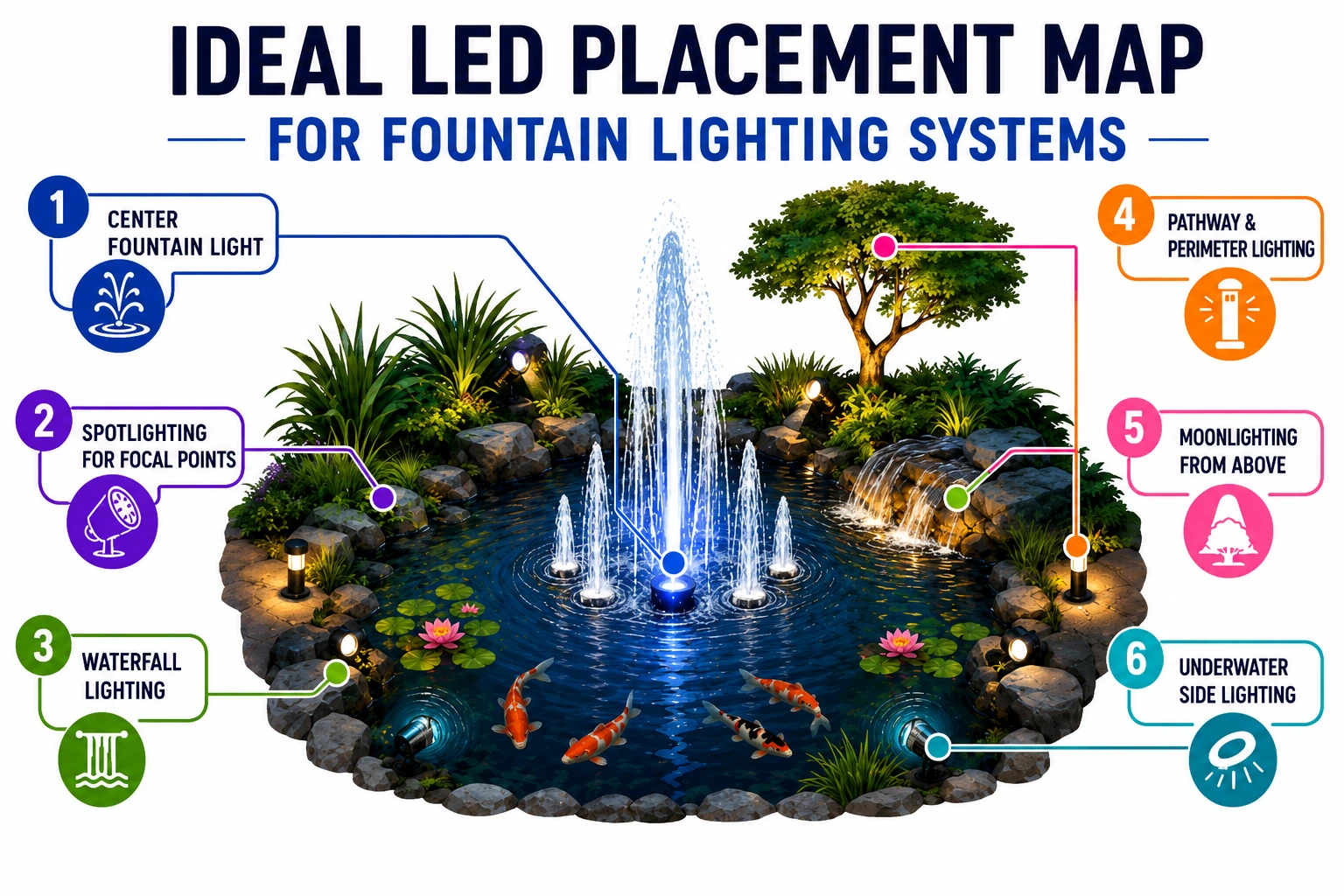
Ideal LED Placement Map for Fountain Lighting Systems
Correct LED placement ensures balanced illumination and seamless visual flow across both white and color fountain lighting.
Conclusion
There’s a huge difference between a basic setup and one that actually stands out at night. It all comes down to the right fountain system and lighting balance. At Friendly Fountains, we provide complete fountain solutions, including pumps, LED lighting kits, and setup options designed for reliable performance and clean installation across all pond sizes. Whether you’re figuring out the right configuration or upgrading your current system, our team is always available to guide you with the right match and support from start to finish.
Get precision-matched fountain systems and lighting configurations from Friendly Fountains engineered for flow efficiency and visual impact.
FAQs
Which LED fountain light lasts longer, white or RGB?
Both last similarly when built with quality drivers and housings, but white LEDs often last slightly longer due to simpler circuitry and lower thermal stress.
Can fountain lights be installed without professional help?
Yes, most fountain lighting systems including basic color-cycling LED kits are designed for simple DIY installation. They operate on a straightforward plug-and-play basis, requiring no controllers, remotes, or professional wiring to get started.
Are LED fountain lights safe for fish and aquatic life?
Yes, low-voltage LED systems produce minimal heat and no harmful radiation, making them safe for fish and maintaining natural pond ecosystems.
Do LED fountain lights increase electricity consumption significantly?
No, LEDs are highly energy-efficient and consume far less power compared to halogen or incandescent fountain lighting systems.
What maintenance is required for fountain lighting systems?
Routine cleaning of lenses and periodic inspection of connectors is usually enough to maintain brightness and prevent mineral or algae buildup.