A floating pond fountain adds visual appeal to a pond, but its installation also requires careful attention to electrical safety. Because the fountain operates in or directly above water, the power supply must be appropriately protected from ground faults and installed to withstand outdoor moisture. Requirements can vary depending on the fountain’s motor wattage, voltage, wiring arrangement, and local electrical code.
The following sections explain the key electrical requirements to consider before powering a floating pond fountain.
Electrical Requirements OverviewA floating pond fountain needs a properly matched power supply, with voltage and wattage determined by the motor and manufacturer specifications. Safe operation also depends on correctly sized circuits, breakers, wiring, grounding, and GFCI protection. Outdoor-rated cables and weatherproof connections help protect against moisture, while long cable runs require voltage-drop consideration. Solar fountains use separate low-voltage systems. Careful planning ensures reliable performance and reduces electrical hazards during operation and maintenance. |
What Power Supply and Voltage Does a Floating Pond Fountain Require?
Power and Voltage Specifications
Floating pond fountains come in a wide range of motor sizes, so no single voltage fits every model.
- Small residential fountains: Many units rated up to approximately 1 HP use 115–120V single-phase power. The actual voltage and amperage should always be confirmed from the fountain’s nameplate and installation manual.
- Larger fountains: Higher-horsepower commercial units may use 230–240V single-phase or three-phase power, depending on the motor and manufacturer. Larger motors generally require appropriately sized circuits and may require professional electrical installation.
- Solar fountains: Small decorative models may use low-voltage DC pumps powered by photovoltaic panels, sometimes with battery storage. These systems have substantially different electrical requirements from AC-powered floating fountains and should be installed according to the supplied controller and pump specifications. For more information on selecting a fountain according to its size, power requirements, and operating specifications, see the complete guide to floating pond fountains.
Wattage and Energy Consumption
Electrical consumption depends primarily on the pump motor and operating conditions. Small decorative fountains may operate at only a few tens of watts
- Low-wattage decorative or solar models: roughly 10–60W
- Residential floating fountains: commonly around 100–400W, although individual models vary considerably
- 3/4–1 HP fountains: substantially higher electrical demand and often better suited to a dedicated circuit, depending on the manufacturer’s specified current and local code
| Looking for a fountain that matches your pond’s size and power needs? Choose an option designed to meet your pond’s performance requirements. |
What Electrical Circuit, Breaker, and GFCI Protection Does a Pond Fountain Need?
GFCI Protection
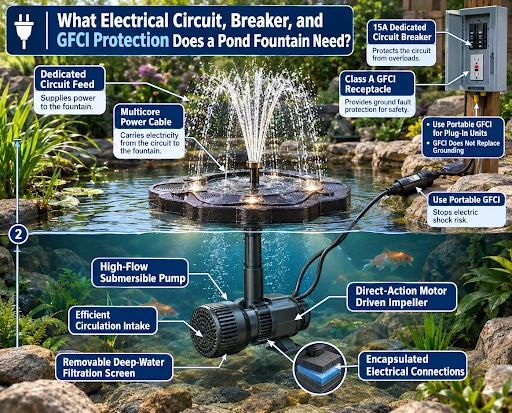
- GFCI protection is essential for fountain installations in wet environments because it shuts off power when it detects unintended current flow, reducing electric-shock risk.
- The U.S. Consumer Product Safety Commission recommends GFCI protection for outdoor receptacles and electrical equipment used near water.
- Connect a plug-in fountain to a properly rated, GFCI-protected outdoor receptacle.
- A portable GFCI must be approved for outdoor use and compatible with the fountain.
- GFCI protection does not replace proper grounding, outdoor-rated equipment, or correctly sized wiring.
Circuit
Size the branch circuit according to the fountain’s rated load and applicable electrical code. Larger motors may require a dedicated circuit.
Circuit breaker
Select the breaker based on the manufacturer’s specified overcurrent protection and the capacity of the installed conductors. Never install a larger breaker simply to prevent nuisance trips.
For additional information on selecting a suitable fountain, explore Friendly Fountains’ Floating Pond Fountains.
How Should Electrical Cable and Power Be Run to a Floating Pond Fountain?
| Component | Requirement |
|---|---|
| Power cable | Use outdoor-rated, properly sized cable |
| Underground run | Follow required burial depth and wiring method |
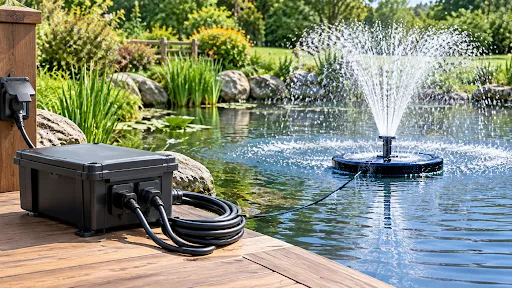
| Water fountain plug | Keep connections above ground and protected from moisture |
| Cable length | Account for voltage drop on long runs |
| Connections | Use weatherproof, code-compliant fittings |
How to Determine the Right Electrical Setup Before Installing a Floating Pond Fountain
- Before installation, check the fountain’s voltage, amperage, horsepower, cord length, and manufacturer-specified circuit requirements. These specifications determine the appropriate wire size, breaker, and power source. For long-distance installations, account for voltage drop and local electrical code requirements.
- A GFCI extension cord for a pool pump should not automatically be used with a pond fountain; its rating and intended application must match the equipment. Likewise, requirements for wiring an above-ground pool and above-ground pool connections should not be transferred to a pond without verifying the applicable code.
- For the fountain itself, confirm that the water fountain plug, receptacle, grounding, and outdoor connections are suitable for the installation environment. When planning installation, refer to the complete guide to floating pond fountains for further practical guidance.
Conclusion
A safe electrical setup keeps a floating pond fountain efficient, reliable, and protected in a wet environment. Choosing the correct voltage, circuit, breaker, wiring, grounding, and GFCI protection is essential for dependable operation. Friendly Fountains offers quality floating pond fountain solutions for different pond applications, making it easier to select the right system for your needs while prioritizing performance, safety, and long-term value.
| Get in touch with Friendly Fountains; we’re happy to help you find an option that works for your pond. |
FAQs About Floating Pond Fountain Electrical Requirements
Does a pond fountain need a surge protector?
A surge protector can provide additional protection against voltage spikes, especially during storms, but it should not replace proper grounding, GFCI protection, or code-compliant wiring.
Can lightning damage a floating pond fountain?
Yes. Lightning and electrical surges can damage motors, controllers, and wiring. Disconnecting equipment during severe thunderstorms can reduce exposure to electrical surge damage.
Can a floating fountain operate during rain?
Many outdoor-rated fountains are designed to withstand normal rain, but electrical connections must remain properly protected, and the manufacturer’s weather-use instructions should always be followed.
Can pond fountain wiring be installed through landscaping?
Yes, when installed using an approved wiring method that meets applicable burial, protection, and routing requirements. Avoid placing cables where landscaping equipment can damage them.
What happens if a pond fountain keeps tripping the breaker?
Repeated trips may indicate overload, a motor problem, damaged wiring, moisture intrusion, or another electrical fault. Stop using the fountain and have the system inspected.