The right pond measurements make it easier to choose a fountain that complements the space and delivers the desired display. However, estimating pond dimensions by eye can make it harder to determine the fountain size and coverage that best suit the water area. This is because ponds vary in length, width, shape, and overall dimensions, making accurate measurement an important step when comparing fountain specifications.
In this blog, we’ll walk through exactly how to measure these dimensions and determine the width of the pond, so you can use accurate measurements when choosing the right fountain size.
Pond Measurement and Fountain Sizing OverviewAccurate pond measurements provide a reliable foundation for choosing the right fountain. Measure length, width, and depth carefully, then calculate surface area using the pond’s shape. Consider how pond size affects circulation, coverage, and fountain capacity, while following the specific manufacturer’s sizing guidance. Avoid estimating dimensions by pacing, taking one depth reading, ignoring seasonal changes, or applying another brand’s specifications when selecting a floating fountain. |
Why Accurate Pond Measurements Matter for Fountain Sizing
Choosing the right fountain starts with understanding your pond’s dimensions. Measuring the water depth, surface area, and available space helps you select a fountain that suits the pond’s size and layout.
- Surface area sets the sizing baseline: Measure your pond’s length and width to estimate its surface area. Larger ponds generally need fountains with wider spray coverage, while smaller ponds suit narrower patterns. Matching spray coverage to pond size helps create balanced circulation and appearance.
- Depth confirms installation suitability: Surface area is only part of the picture. Knowing the depth of a pond helps you check whether the water is deep enough for the fountain’s operating requirements and installation conditions.
- Shape affects spray pattern selection: A long, narrow pond may suit a fountain with a narrower, more directional spray, while a wide pond can accommodate broader patterns. Measuring the pond’s shape helps match the fountain’s spray to the available water area.
With these details, you can compare fountain specifications against the pond’s actual dimensions rather than relying on appearance alone.
How to Measure Pond Length, Width, Depth, and Surface Area
Knowing how to measure a pond correctly means taking each dimension consistently. A tape measure, marked rope, or measuring line can work for smaller ponds, while a mapping tool can be useful for larger or irregular water bodies. Keep all measurements in the same unit so your calculations remain consistent.
Measure the Pond Length
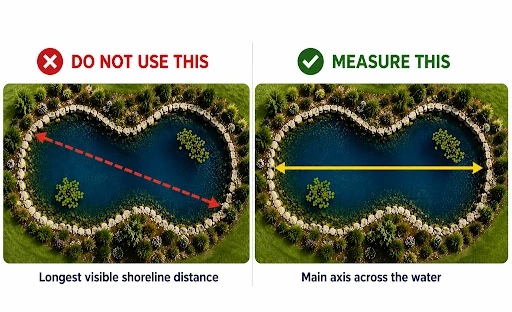
Measure the longest practical distance across the water from one shoreline to the opposite shoreline. For an irregular pond, do not automatically use the longest visible shoreline distance as the length. Instead, identify the main axis that best represents the pond and record that measurement. This gives you a useful dimension for calculating or estimating the surface area.
Determine the Width of the Pond
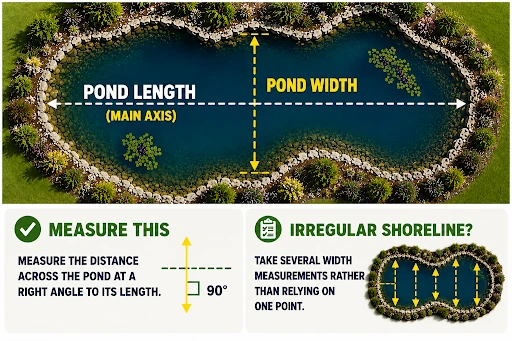
Measure the distance across the pond at a right angle to its length. If the shoreline changes considerably from one section to another, take several width measurements rather than relying on one point. Multiple measurements provide a better representation of the pond, particularly when estimating an irregular shape.
Measure the Depth of the Pond
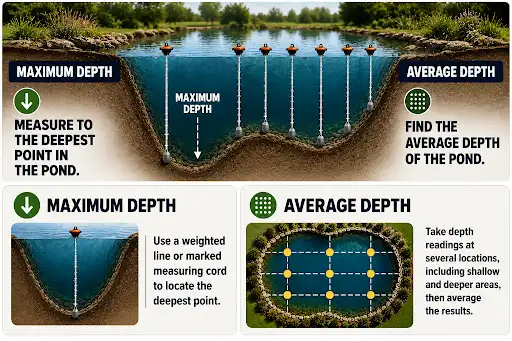
Maximum depth and average depth are different measurements.
- To find the maximum, use a weighted line or marked measuring cord to locate the deepest point.
- For average depth, take readings at several locations across the pond, including shallow and deeper areas, then add the measurements and divide by the number of readings.
Penn State Extension recommends measuring depth at multiple points to obtain a more representative average.
Calculate the Pond’s Surface Area
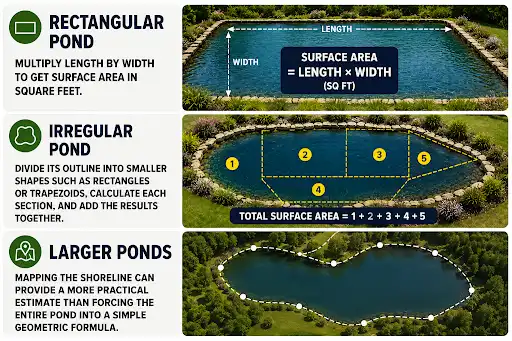
For a rectangular pond, multiply length by width to get surface area in square feet. If the pond is irregular, divide its outline into smaller shapes such as rectangles or trapezoids, calculate each section, and add the results together. For a more detailed explanation of the calculation, see our guide on how to calculate pond surface area for fountain sizing
Once you record these measurements, you have the basic dimensions needed to compare the pond against fountain specifications and move from estimation to a more informed size selection.
| Not sure how to measure your pond accurately? Friendly Fountains can assess your pond on-site and help determine the right fountain for it. |
How Pond Dimensions Affect Fountain Size Selection
With your pond’s length, width, depth, and surface area in hand, the next step is turning those numbers into the right fountain choice. Here’s how each dimension actually influences that decision.
Why Surface Area Is the Primary Sizing Metric
Surface area is the single most useful number when comparing fountain options, and it’s the figure most manufacturers build their sizing charts around. Once you know your pond’s surface area, you can match it against a fountain’s rated capacity instead of guessing based on appearance or price point alone.
How Pond Size Affects Circulation and Coverage
Larger ponds need more from their equipment not just a bigger spray, but genuine circulation across the available surface. A fountain that looks impressive on a small pond can barely stir the water on a larger one, leaving parts of the pond stagnant even while the display looks active near the unit itself. This matters most when aeration, not just aesthetics, is the goal. If you’re comparing different fountain designs and their applications, this complete guide to floating pond fountains provides useful context before you narrow down your options.
Why One Universal Formula Doesn’t Work
Surface area isn’t applied the same way across every brand. Manufacturer sizing charts vary; some relate capacity to surface area, while others use horsepower, flow rate, or model-specific specifications. Two fountains with similar surface-area ratings can perform very differently in practice. Always check the sizing chart for the specific fountain you’re considering rather than relying on a rule of thumb pulled from a different manufacturer’s guide. Comparing specifications across different floating pond fountains can also help you identify which options best match your pond’s requirements.
Common Measurement Mistakes to Avoid Before Choosing a Fountain
Even careful pond owners can make measurement mistakes that affect fountain selection. UF/IFAS Extension explains that proper fountain sizing helps reduce problems such as shoreline erosion and sedimentation associated with an unsuitable fountain.
- Pacing instead of measuring — stride length varies more than most people realize, and a small error here can push you toward the wrong fountain size when you determine the width of the pond.
- Treating an irregular pond as a rectangle — multiplying the longest length by the widest point overstates surface area on kidney-shaped or oval ponds; breaking the shape into smaller sections gives a truer number.
- Taking one depth reading — pond bottoms aren’t flat, so a single check misses deeper stretches; averaging several readings gives a realistic depth of a pond.
- Skipping depth entirely — most floating fountains need close to two feet of clearance under the float to run safely, regardless of surface area.
- Ignoring seasonal shifts — runoff, erosion, and sediment buildup change pond size over time.
- Applying another brand’s sizing chart — always check the specific manufacturer’s numbers for your fountain.
Conclusion
Getting your pond size right from the start makes every decision after it easier, from fountain selection to long-term maintenance. Friendly Fountains offers a full range of floating fountains, sizing support, and installation guidance, helping pond owners turn accurate measurements into a display that actually performs the way it should.
| Your pond’s numbers are ready; let’s match them to a fountain built to handle them. |
Frequently Asked Questions About Measuring a Pond for Fountain Sizing
How often should I re-measure my pond?
Once a year is a good baseline, ideally after spring runoff or heavy rain, since bank erosion and sediment shifts can change dimensions enough to affect fountain performance.
What’s the difference between a fountain and an aerator?
A fountain circulates surface water and adds visual display; an aerator focuses on oxygenating the full water column, which matters more in deeper ponds.
How deep does my pond need to be for a floating fountain?
Most floating fountains require roughly 18 to 24 inches of clearance beneath the float to keep the motor cool and avoid pulling in sediment.
Can I use satellite imagery instead of manual measuring?
Satellite or mapping tools work well for large or irregular ponds, giving a reasonable outline estimate, though physical measurement is more accurate for smaller water bodies.
What unit should I use when measuring feet or acres?
Measure in feet for length, width, and depth, then convert surface area to acres by dividing square footage by 43,560 for fountain sizing charts.